01What it is
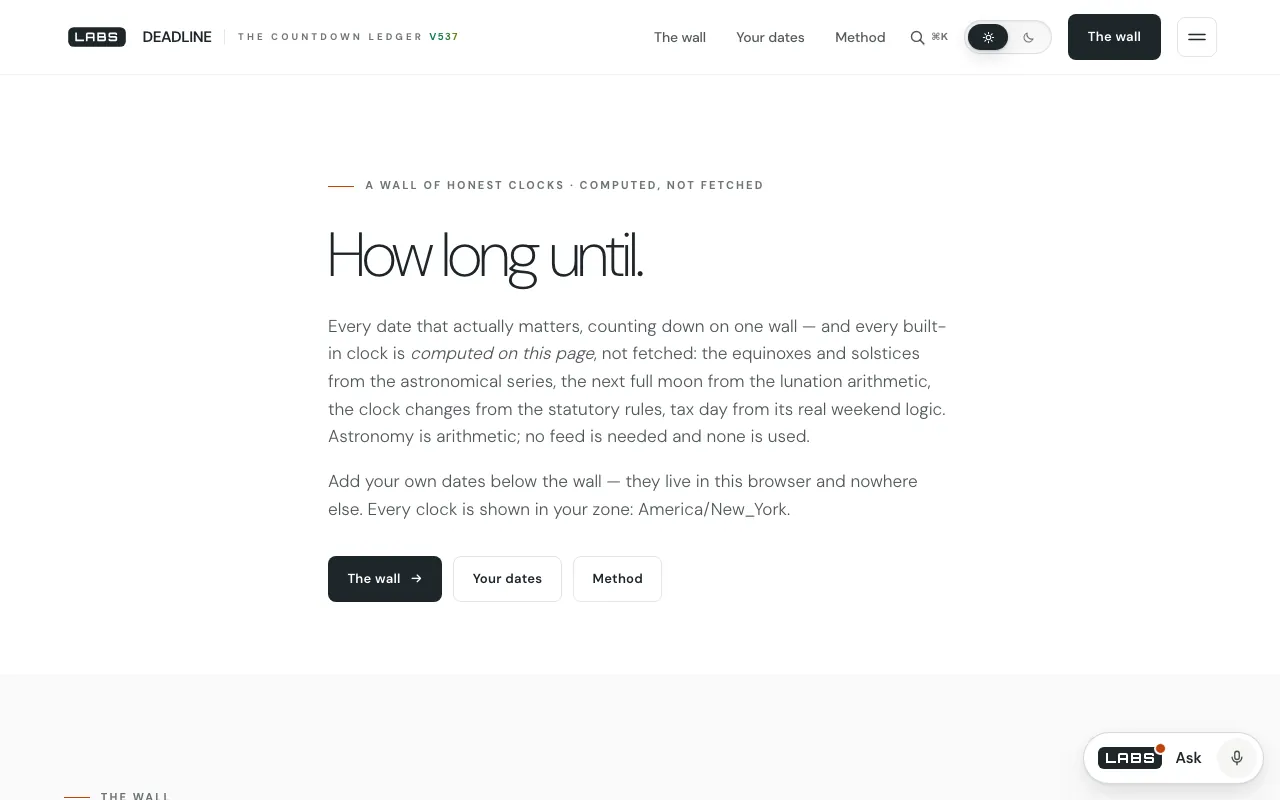
Deadline is a wall of countdown clocks in which every built-in date is worked out by the page. The wall covers the next equinox or solstice, the next full moon, the next US and EU clock changes, US tax day, the quarter's end, the next Friday the 13th, leap day, Christmas, New Year and the 2038 limit of 32-bit Unix time. You can add dates of your own, which stay in your browser.
It is for freelancers and finance people watching quarter ends and tax day, for sky-watchers, and for anyone counting down to something personal.
02How it works
It is one 255-line script (deadline/assets/js/deadline.js) that makes no network request at all. The seasons use Jean Meeus's polynomials with his full 24-term periodic correction (Astronomical Algorithms, chapter 27); the full moon uses his chapter 49 lunation series (deadline.js:23-80). Clock changes follow the rules as written: the US second Sunday of March and first Sunday of November at 02:00, and the EU last Sundays of March and October at 01:00 UTC under directive 2000/84/EC. Tax day starts at 15 April and steps past weekends and Washington DC's Emancipation Day (deadline.js:101-126).
Each card prints its method and its expected accuracy, such as “good to a couple of minutes” for the seasons, and the page names the time zone it read from your browser. Your own dates sit in localStorage; if the browser refuses storage, the page warns that they will not survive a reload (deadline.js:203-208, 225-227, 252-253).
03The test
| UTC | What we did | What came back |
|---|---|---|
| 20:02:53 | September equinox 2026: page vs USNO | Page 23 Sep 00:05:30 UTC; USNO 00:05. |
| 20:02:53 | December solstice 2026 | Page 21 Dec 20:50:13 UTC; USNO 20:50. |
| 20:02:53 | Full moons, 26 Sep and 26 Oct | Page 16:48:40 and 04:10:31 UTC; USNO 16:49 and 04:12. |
| 20:03:18 | Page, local 537 copy | HTTP 200, 41,332 bytes. |
We lifted the page's own season and full-moon functions (deadline.js:21-81), ran them in JavaScriptCore, and asked the US Naval Observatory's API for the same events. The seasons land within a minute and the moons within two, as the cards promise.
04Against the field
Each comparator was read on its own site on the date shown. We credit what each does better before saying where Deadline goes further.
timeanddate.com, Countdown Timer
27 Sep 2026, 20:07 UTC, through a search of timeanddate.com.
Builds a countdown to any date and time, tied to the event's location and time zone, as a URL you can bookmark or share; also a free countdown widget for websites.
Where it does better
- Ties each countdown to the event's own place and zone, which Deadline does not do for its US clock-change card or your dates.
- A shareable link for every countdown, and an embeddable widget.
Where Deadline goes further
- Computes the astronomy itself, and the September equinox matched the Observatory to within a minute.
- A ready-made wall of rule-based dates, each printing its rule.
US Naval Observatory, Earth's Seasons and Apsides
Fetched 27 Sep 2026, 20:07 UTC; its API answered at 20:03 UTC.
The Observatory's service for equinoxes, solstices, perihelion and aphelion for any year from 1700 to 2100, in Universal Time, US zones or a custom offset.
Where it does better
- It is the authority: the reference we checked Deadline against.
- Any year from 1700 to 2100, plus perihelion and aphelion.
Where Deadline goes further
- A live, ticking countdown to the next event, beside moons, clock changes and civil dates.
- Works offline once loaded, because no built-in date needs a request.
05Where it falls short
- The US clock-change card counts to 02:00 in your own zone (
deadline.js:103-104). For a reader outside the US, that is not the moment any US zone changes. - Your dates live in one browser only: no sync, no share link, no calendar export and no notification were found in the code.
- The built-in list is fixed and centred on the US and EU, with no choice of country.
- TT−UTC is held at 69 seconds (
deadline.js:41): sound for now, a guess for dates far from 2026.
06Filing note
File underDates you can check: computed in the open, with the rule on every card.
Deadline is a small page that shows its working, and the working holds up against the Observatory. It would be stronger with a share link and a way to set a card's zone. For a single countdown to send to friends, timeanddate.com does more; for a wall of dates that needs no network and states its rules, this is the sheet to keep open.
07Spec sheet
| Address | labs.llc/deadline/ |
|---|---|
| Where it runs | In your browser; no network requests |
| Methods | Meeus ch. 27 and 49; US statute; EU directive 2000/84/EC |
| Checked accuracy | Seasons within 1 min, moons within 2 min of USNO |
| Your dates | localStorage only |
| Account | None |
| Measured | 27 Sep 2026, 20:02–20:03 UTC |
| Set against | timeanddate.com Countdown; USNO |
| Main limit | Zone handling; no export or sharing |