01What it is
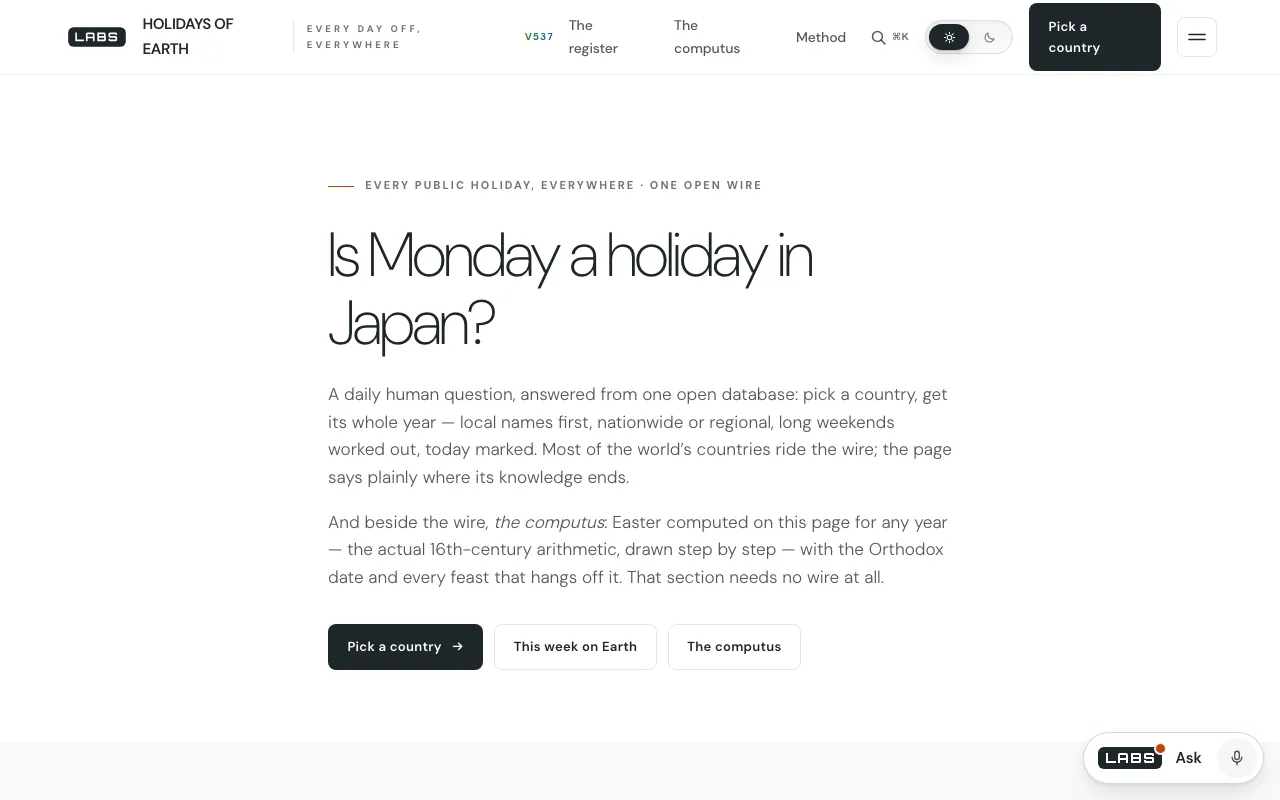
Holidays lists the public holidays of any country in the Nager.Date open database: local and English names, nationwide or regional scope, long weekends with the bridge days that make them, today marked, and a worldwide list of what comes next. Below it sits a computus that works out Western and Orthodox Easter for any year from 1583 to 4099, showing the arithmetic line by line, with the feasts that hang off Easter.
It is for people planning travel, leave or business across borders, and for anyone who has wondered how Easter's date is found.
02How it works
Everything runs in the browser (holidays/assets/js/holidays.js, 183 lines) from one keyless wire that allows any origin, date.nager.at/api/v3: country list, a year's holidays, long weekends, today's status and the worldwide next list. The first country is guessed from your browser's language region and then remembered. Each holiday shows its local name beside the English one and whether it is nationwide or how many regions keep it; long weekends name the bridge days to book (holidays.js:43-49, 88-104).
The computus uses no network. Western Easter follows the Anonymous Gregorian algorithm, each quantity explained: the year's place in the moon's 19-year cycle, the epact, the days to Sunday. Orthodox Easter uses the Julian reckoning converted to the Gregorian calendar, and seven moveable feasts follow, Carnival Monday to Corpus Christi (holidays.js:131-180). Failures on the wire are put into words, and the page notes that the computus still works if the country list does not.
03The test
| UTC | What we did | What came back |
|---|---|---|
| 20:03:39 | Page, local 537 copy | HTTP 200, 48,263 bytes. |
| 20:03:39 | Country list, with a browser Origin header | HTTP 200 in 0.18 s, any origin allowed: 204 countries (the script's header still says “around 110”; the page counts live). |
| 20:03:39 | Japan 2026, GB long weekends, US today, worldwide | Japan: 16 holidays, including 敬老の日 on 21 Sep. GB: 4 long weekends, the first 3–5 April, no bridge day. US: HTTP 204, not a holiday. Worldwide: 28 entries. |
| 20:14:26 | Page's Easter functions vs the wire's GB and GR calendars | 2026: Western 5 Apr, Orthodox 12 Apr. 2027: 28 Mar and 2 May. All four agree with the database. |
Two things stand out in that log. The country list is far longer than the script's header says (204 against “around 110”), and the page copes because it counts the list live rather than trusting the comment. And the Easter check is independent: the page computes its dates with no network, the database lists them from its own records, and the two agree for both churches in both years.
04Against the field
Each comparator was read on its own site on the date shown. We credit what each does better before saying where Holidays goes further.
timeanddate.com, Holidays and Observances
27 Sep 2026, 20:07 UTC, through a search of timeanddate.com; its pages on why and how holidays are kept re-checked at 20:46 UTC.
Holiday and observance calendars, about 7,000 entries from 230 countries, with filters, extra layers such as clock changes and seasons, and a paid Holidays API with state-level data.
Where it does better
- Wider coverage, and observances as well as public holidays.
- State-level lists and a commercial API.
- Background on why and how each day is kept.
Where Holidays goes further
- Shows how Easter is found, step by step, for any year from 1583 to 4099, with the Orthodox date alongside.
- Names the bridge days a long weekend needs.
Office Holidays
Fetched 27 Sep 2026, 20:07 UTC.
Public and bank holiday calendars for key countries, with regional and religious pages, calendars by year, year planners and upcoming lists.
Where it does better
- Regional and religious holiday pages and year planners.
- Context for employers, such as holiday pay rules.
Where Holidays goes further
- Guesses your country from the browser, remembers it and marks today in the table.
- Runs from an open, keyless database read by your browser, and names it.
05Where it falls short
- Public holidays only, from one database: no observances, school holidays or religious days that are not public holidays, and only a few years either side of now. The page says so.
- A regional holiday shows how many regions keep it, not which ones (
holidays.js:88-90). - No calendar export or subscription was found in the code.
- One request is wasted. Today's status is fetched on every country change and then discarded, since today is marked by comparing dates (
holidays.js:82-85).
06Filing note
File under“Is it a holiday there?”, with the Easter arithmetic shown in full.
Holidays is thin on the wire and deep on the computus. It answers the everyday question quickly and credits its source, and its Easter section is a real piece of teaching whose results we confirmed. The discarded request is a small blemish, easily fixed. For observances, regional detail or a calendar feed, go to timeanddate.com or Office Holidays.
07Spec sheet
| Address | labs.llc/holidays/ |
|---|---|
| Where it runs | In your browser; no relay |
| Source | Nager.Date (date.nager.at/api/v3), keyless |
| Countries at test | 204 |
| Computus | 1583–4099, Western and Orthodox, offline |
| Remembers | Your country, in localStorage |
| Export | None found |
| Measured | 27 Sep 2026, 20:03 and 20:14 UTC |
| Set against | timeanddate.com Holidays; Office Holidays |